



The European University on Responsible Consumption and Production (EURECA-PRO), in which the Technical University of Crete (TUC) participates as a founding member since 2020, organizes targeted capacity-building training seminars, workshops, and joint events to help students, researchers, and university staff enhance their skills, build institutional peer networks, and expand their international research horizons.
On Thursday May 7th, 2026 representatives from Technology Transfer Offices (TTOs) of EURECA-PRO partner universities met virtually to share their blueprints for turning ideas into impact. The presentations and discussion highlighted several best practices for successful technology transfer and innovation support across the EURECA-PRO alliance.
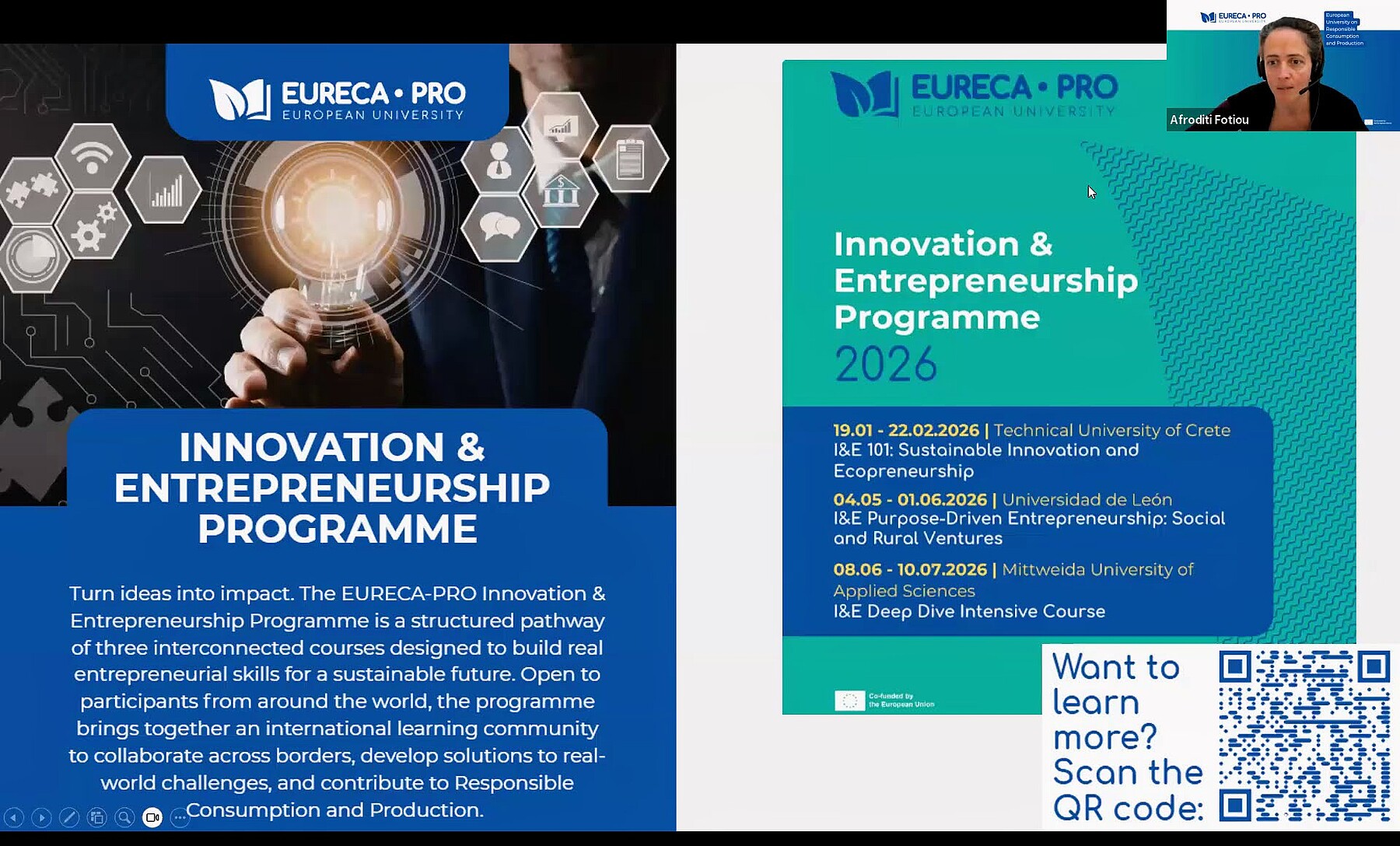
The discussion was facilitated from Afroditi Fotiou, member of the EURECA-PRO team at the Technical University of Crete (TUC), who initiated the conversation with a short introduction on EURECA-PRO’s approach to Research and Innovation and Entrepreneurship (I&E), as well as insights from the young and dynamic TTO at TUC.
One key takeaway was the value of a strong and well-integrated support structure. Anneke Kennens, Communication and Projects Manager in Tech Transfer Office of Hasselt University (HU), showcased a centralized TTO of 31 people, where legal experts, spin-off creators, and decentralized business developers work side-by-side with researchers to foster an entrepreneurial mindset. Key highlights include a "Valorization Academy" and a powerful connection to Flanders’ regional ecosystem.
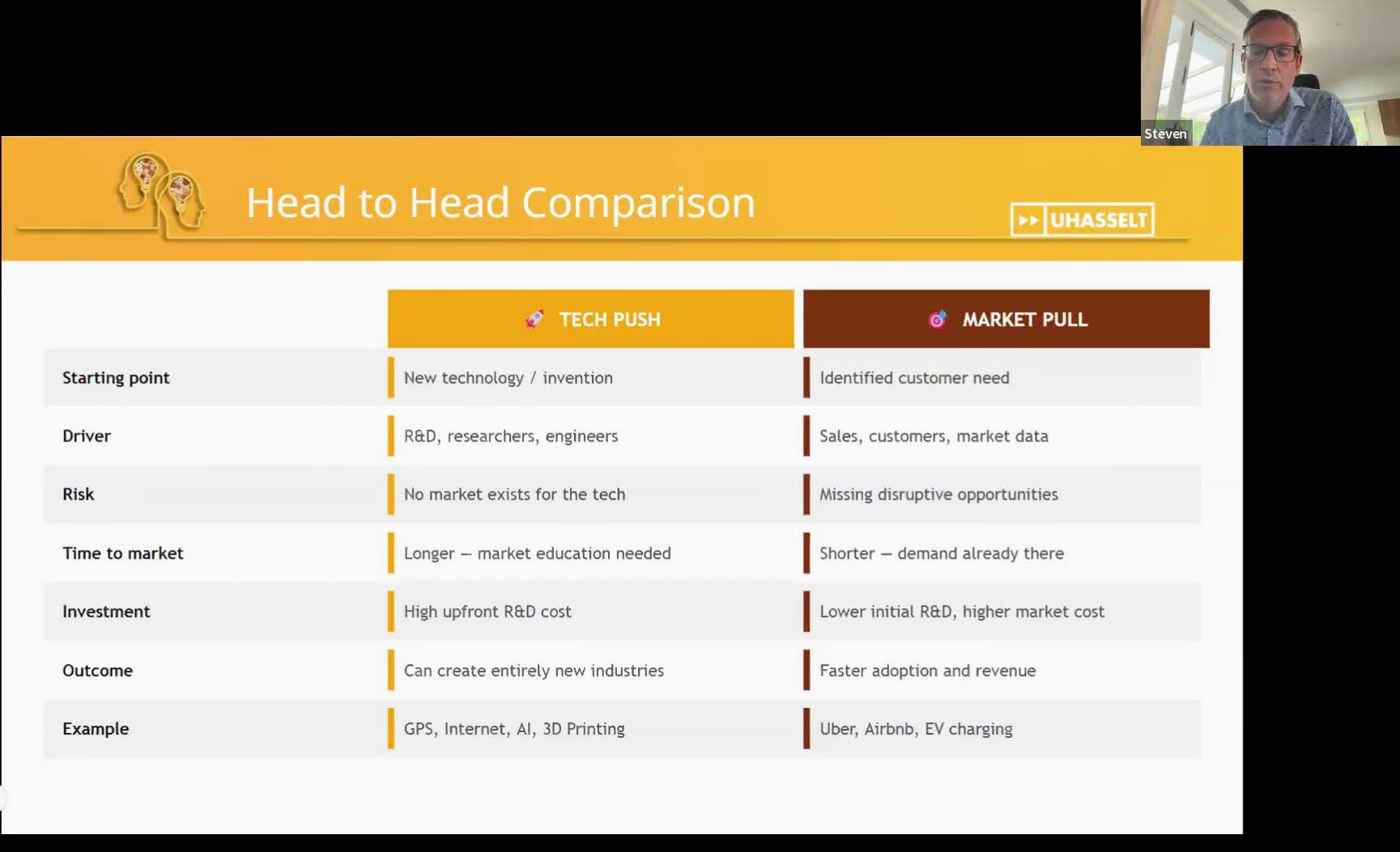
Another important lesson focused on user-centred innovation. Steven Palmaers, Business Developer in the Digital Future Lab of Hasselt University (HU), introduced Flanders Make, a strategic research center with a human centered approach. He tackled the classic dilemma—Tech Push vs. Market Pull strategy —and concluded that the best innovation bridges both worlds. Whether reinventing cleanroom training or monitoring worker well-being, the golden rule remains: validate early and involve real users.
Long-term collaboration emerged as a third success factor. Karin Rehatschek, Director of the Research and Innovation Service of the Technical University of Leoben (TUL), focused on two topics. She introduced the institute and its service portfolio and presented the "TechFair" event as a best practice example to reinforce networking of researchers with the regional ecosystem. The Technology Transfer Office of TUL counts 25 years of operation and 14 staff members. At TUL, technology transfer activities are based on long term relationships with industrial stakeholders. With structured initiatives like "Science Fit" that enable visits in Styrian SMEs and "COoperation INnovation" for technology and know-how development of SMEs, small projects lead to long-term collaborations.
All parties agreed that the human factor is an essential driver of innovation, either on involving people in making tomorrow’s technology, fostering research on adaptive reuse or investing in long-lasting, trustful collaborations, the societal impact of innovation makes the difference. The presented examples illustrated how smaller projects can serve as entry points for lasting partnerships that create value for both academia and industry.
Across all presentations, a common message became clear: successful technology transfer is not only about processes, funding, or intellectual property. It is ultimately driven by people, trust, and collaboration. Whether through entrepreneurship support, user engagement, or long-term partnerships, the most impactful innovations emerge when strong networks connect research with societal and industrial needs.
You may watch the video of the event and read a related article on EURECA-PRO's website.
EURECA-PRO is funded by the European Union under the Grant Agreement No 101124439 "EURECA-PRO 2.0". Views and opinions expressed are however those of the author(s) only and do not necessarily reflect those of the European Union or the European Education and Culture Executive Agency (EACEA). Neither the European Union nor EACEA can be held responsible for them.